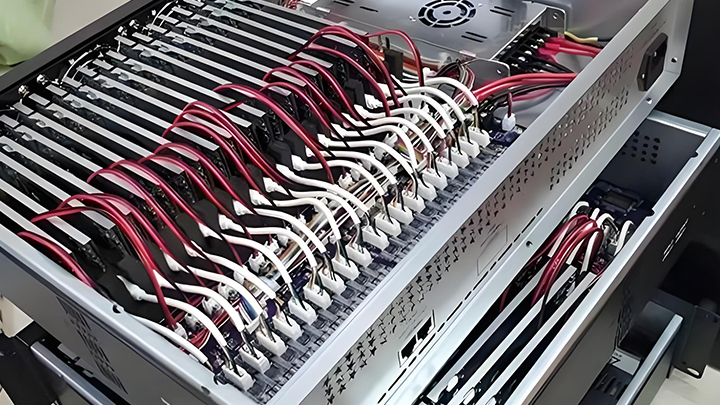





From 20 to Thousands – Scaling Mobile Automation with Phone Farm Boxes
One of the most impressive claims of the Phone Farm Box is that one set of machines is equivalent to 20 mobile phones, and multiple sets can be connected to a single computer, allowing that computer to control thousands of mobile phones simultaneously. This scalability is the key to modern mobile automation. In this article, we explore how the Phone Farm Box enables massive‑scale control without the complexity that used to require entire server rooms.
Understanding the Scaling Formula
Let us do the math. One Phone Farm Box manages 20 devices. If you need to control 200 phones, you simply deploy 10 boxes. These 10 boxes connect to one host computer via a USB hub or network switch (depending on the model). The computer sees each phone as an individual device, but group control software allows you to issue the same command – open an app, click a button, swipe a screen – to all 200 phones at once.
Now push further. A single high‑end computer can typically handle 500 to 1,000 connected devices if the group control software is well‑optimized. With 25 boxes (500 phones) or 50 boxes (1,000 phones), the Phone Farm Box architecture remains clean and manageable. The host computer does not need 1,000 separate USB ports; it only needs 50 connections (one per box). This drastically reduces driver conflicts, USB bandwidth bottlenecks, and software crashes.
Practical Applications of Thousand‑Phone Control
Who needs to control thousands of phones? Several legitimate industries benefit:
- App store optimization (ASO) agencies – To test how an app ranks under different user behaviors, they may deploy 1,000 virtual (or real) devices running automated scripts that simulate downloads, ratings, and reviews.
- Performance testing labs – Before launching a major app, companies simulate peak traffic using thousands of real phones to find server bottlenecks.
- Ad verification companies – They use phone farms to check whether digital ads are displaying correctly across thousands of device models and network conditions.
- Social media management (within terms of service) – Some legitimate marketing firms use group control to post content across many accounts for brand campaigns, though they must avoid spam violations.
How the Phone Farm Box Simplifies Massive Deployments
In a traditional setup, 1,000 phones would require:
- 1,000 USB chargers and 1,000 data cables
- Multiple 50‑port USB hubs (20+ hubs)
- A massive custom rack (often 10–15 feet long)
- Industrial cooling fans
- Constant manual checking for swollen batteries
With Phone Farm Boxes, the same 1,000 phones fit into 50 boxes. These boxes can be stacked in a small server cabinet, occupying perhaps 6–8 square feet of floor space. Each box has its own cooling design, so no external fans are needed. The single host computer runs the group control software, and the entire farm can be monitored remotely via a dashboard that shows temperature, connection status, and battery health (if batteries are present) for every single device.
Important Considerations
While the hardware is ready, success also depends on software. Good group control software should support screen mirroring, script recording, batch installation of apps, and file transfer to all devices simultaneously. Some advanced systems even allow individual device control within the group – for example, telling phone #37 to behave differently from phone #38 during an A/B test.
Another consideration is network infrastructure. Controlling thousands of phones often means each phone needs its own IP address (via Wi‑Fi or Ethernet adapters). The Phone Farm Box typically provides Ethernet or Wi‑Fi modules per device, but large farms may require a subnet with hundreds of IPs.
The Future: Even Larger Scales
As group control technology improves, we can expect boxes that handle 50 or even 100 devices per unit, with 10GbE uplinks to host computers. The Phone Farm Box is already a huge leap forward, turning what once required a warehouse into something that fits on a few shelves. For businesses that rely on mobile automation, the ability to start with 20 phones and scale seamlessly to thousands – without re‑engineering the entire setup – is not just convenient; it is a competitive necessity.